Photographing Fuego at Night
How to photograph Fuego erupting from Acatenango: tripod, lenses, starting exposures of 5 to 15 seconds, focusing in the dark, phone night mode and the cold.
To photograph Fuego at night, set your camera on a tripod at camp on Acatenango, focus by hand on the crater before dark, and start with exposures of about 5 to 15 seconds at a high ISO and your widest aperture, then adjust after each burst. The explosions are short and come without warning, so you set up early and leave the camera ready. INSIVUMEH’s bulletin of 12 November 2026 logged 3 to 6 explosions an hour, some throwing glowing rock about 100 m above the crater, and its bulletins from 31 October to 12 November ranged from 1 to 8 an hour. Cloud can still hide the volcano all night, and no tour can promise a display. Treat every setting below as a starting point to adjust on the night.
Check Availability
Gear to carry up Acatenango
Everything you bring, you carry up about 1,500 m of loose volcanic ground over 4 to 6 hours, so pack for the shots you want and leave the rest in Antigua. A light travel tripod is the one item you should not skip. Long exposures need a camera that does not move, and the wind at camp shakes a flimsy tripod, so hang your bag from the center column. If you leave the tripod behind, a flat rock or a small beanbag will hold a camera steady.
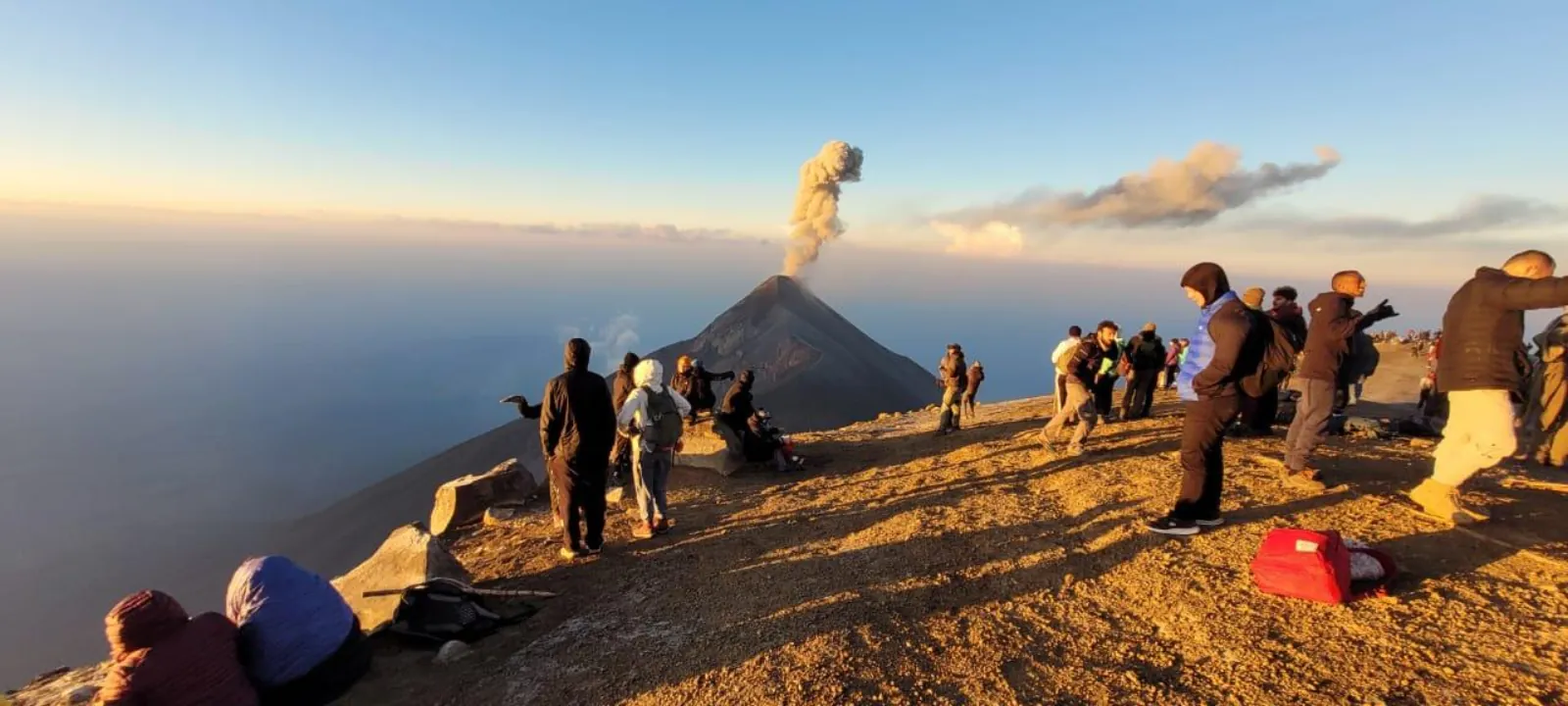
For lenses, a wide zoom (around 14 to 24 mm on a full-frame camera) fits the tents, the sky and Fuego in one frame. A short telephoto, around 85 mm, pulls in the crater and the arcs of glowing rock. The two summits stand about 3 km apart across a deep saddle, and the camps sit at roughly 3,400 to 3,750 m, close to the height of Fuego’s 3,763 m crater, so you look across at the eruptions, not up at them.
Add a remote release or use the camera’s 2- or 3-second self-timer, so pressing the button does not blur the frame. Bring at least two spare batteries, a headlamp with a red-light mode, and a lens cloth for the ash dust that coats everything on the trail.
Starting exposures for the night glow
Switch to manual mode and turn off autofocus and image stabilization once the camera sits on the tripod. These starting points come from photographers who have shot Fuego, and from general night-photography practice:
| What you are shooting | Aperture | ISO | Shutter |
|---|---|---|---|
| An eruption from camp, wide lens | widest (f/2.8 to f/4) | 1600 to 3200 | 5 to 15 s |
| Fuego with stars, wide lens | widest | about 2000 | up to 20 s |
| Crater close-up, short telephoto | widest | about 3200 | about 4 s |
| Ash column at dusk or sunrise | f/8 | 200 to 400 | as metered |
Take a test frame as soon as it is dark, then check the histogram. Glowing rock is far brighter than the sky around it, so a burst can turn the crater into a white blob while the rest of the frame looks right. If that happens, shorten the exposure or drop the ISO for the next frame. Bracket two or three exposures when a big burst starts, and you can blend them later.
Exposure length changes the look. A 10- to 15-second frame records glowing rock as streaks arcing down the cone, while a few seconds shows the burst closer to how your eye sees it. Open up when a glow starts to build and stop down as it fades. Leave the camera on continuous shooting with the remote in your glove, and fire as soon as you see the flash, since the boom only reaches you a few seconds later.
Other Experiences
Other experiences you might enjoy
Overnight Acatenango tours from Antigua with a night at a camp facing Fuego, from budget group climbs to small-group cabin trips.
Focusing when you cannot see the crater
Autofocus hunts in the dark and usually fails on a black mountain. Focus while there is still light: at dusk, aim at Fuego’s summit, zoom in on the screen, focus by hand until the ridge line is sharp, then switch the lens to manual. A strip of tape across the focus ring stops it slipping when you pull on gloves or move the tripod.
If you arrive after dark, use live view, magnify the screen as far as it goes, and focus on a bright star or on the glow itself during a burst. The infinity mark on many lenses is not exact, so do not trust it. After the first eruption, zoom into the playback image to check the crater edge, and refocus if it looks soft.
Framing the camp, the tents and the sky
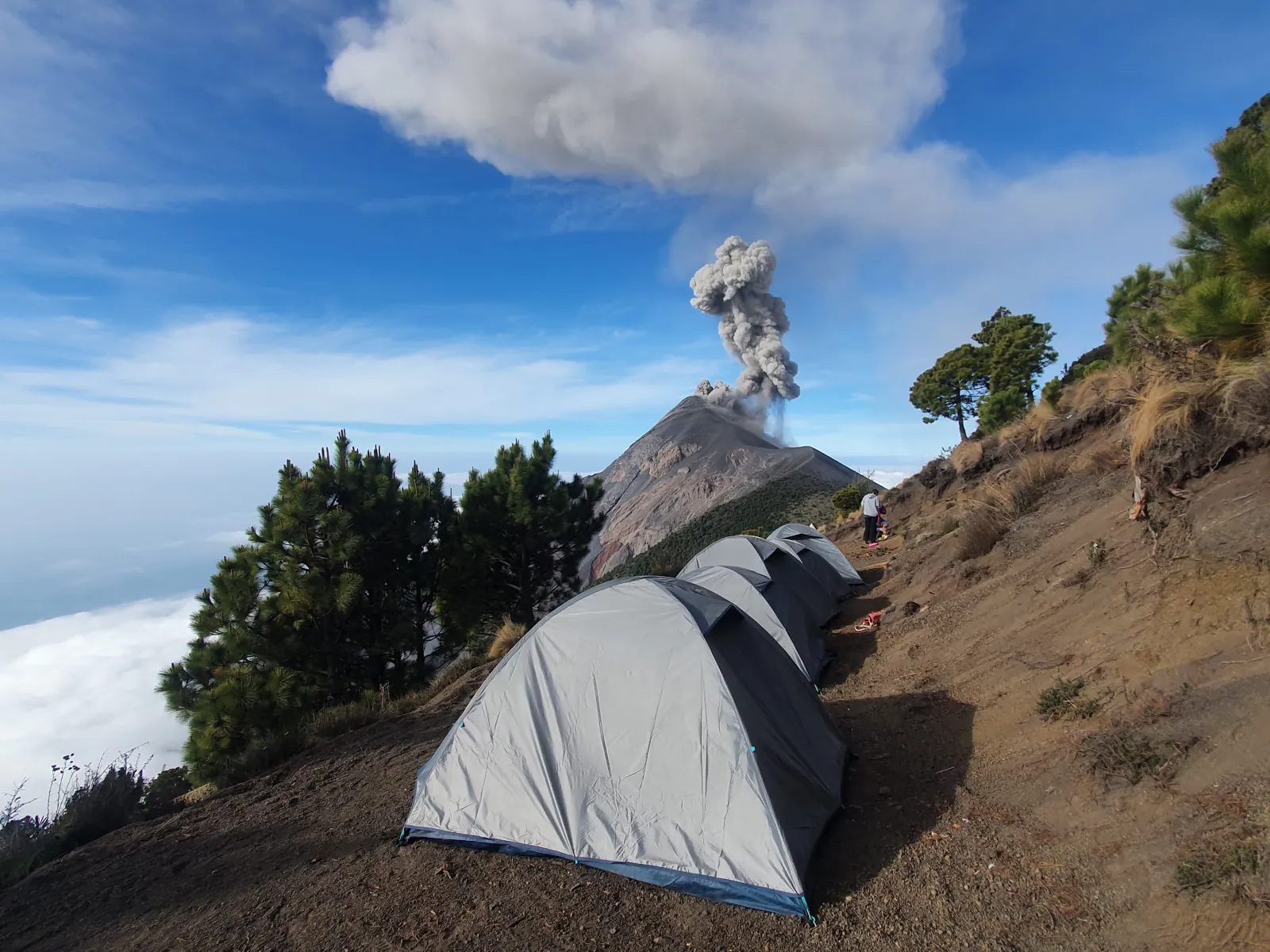
A lone orange burst on black makes a striking first frame, but the photos people remember usually show scale. Put a tent, a cabin roof or the pines in the foreground and let Fuego sit in the upper third. A tent lit from inside by a dim headlamp glows against the dark slope and needs no extra light. If you want a person in the shot, ask first, and have them stand still for the whole exposure.
On a clear, dark night the stars over the cone add depth. Keep stars as points by staying near 20 seconds or less with a wide lens. Clear nights are more likely in the dry season from November to April; see the best time to see Fuego for the month-by-month picture.
Morning brings different pictures. From Acatenango’s 3,976 m summit at sunrise you can stand above the clouds with Fuego smoking below, and the ash column catches the first light. Switch back to short exposures and a lower ISO.
Shooting with a phone
Modern phones can catch Fuego’s glow if you keep them still. Turn on night mode, brace the phone on a rock, a pack or a small phone tripod, and tap to lock focus on the summit. Then lower the exposure by one or two stops, so the burst does not wash out. Start a long night-mode capture as soon as the glow begins. Many phones also let you record video and pull a still from the frames, which helps when the bursts come between captures.
Working in the cold
Expect freezing temperatures. Model estimates put average lows at Acatenango’s summit at or below 0 °C in every month, and at about −2 to −3 °C from November to March; the camps are a little warmer. Batteries drain fast in that cold. Keep the spares in an inner pocket against your body and swap them as the camera slows. Standing still behind a tripod chills you faster than hiking, so wear every warm layer and thin liner gloves that let you work the buttons.
Before you carry a cold camera into a warm tent or cabin, seal it in a plastic bag and leave it closed for about 20 minutes. Moisture then condenses on the bag, not inside your lens.
Sharing the camp after dark
Most of your camp goes to bed early, because the summit push usually leaves between 3:30 and 4 a.m. Shoot from the edge of camp, turn off shutter and timer beeps, and never use flash. Switch your headlamp to red, keep it pointed at the ground, and turn it off when other people are shooting, because a white beam across the frame ruins a 15-second exposure.
Stay inside the camp area your guide shows you. Do not walk toward La Meseta or El Camellón for a closer shot: INSIVUMEH’s bulletin of 7 November 2026 warned that ballistic material can land more than 500 m around the crater and advised people not to stay on La Meseta. Climbing Fuego has been banned since the Municipality of Acatenango’s ruling of 1 April 2026; the ban explained covers the details.
If a bed facing the volcano matters for your photos, the small-group eruption-view cabins cap the group at 6 hikers, say on the listing that Fuego is visible from the cabin on a clear night, and include the park fee, from US$170 per person on GetYourGuide, with free cancellation up to 24 hours before. It is rated 4.4/5 from 20+ reviews there, a small sample. One lower-rated review says a Spanish-speaking guide came when English was requested, so confirm the language. The listing also offers an optional 3-hour trek toward Fuego; that hike is banned under current rules, so do not book it (our review). We earn a commission if you book through our links, at no extra cost to you.
When the cloud wins
Some nights the cloud never lifts. You can still follow Fuego through INSIVUMEH’s camera page, which refreshes every minute and keeps a video of the last 6 hours for each camera, and through the Volcanological Society’s livecam when it is working (it was out of order on 13 November 2026). Those images belong to their operators, so link to them; do not post them as your own. The Fuego live cam page lists the official feeds.
Frequently asked questions
What camera settings work for Fuego at night?
Start in manual mode at your widest aperture (f/2.8 to f/4), ISO 1600 to 3200 and 5 to 15 seconds on a tripod. Check the histogram after each burst and shorten the exposure if the glowing rock turns white.
Do I need a tripod to photograph Fuego?
For long exposures, yes, or at least a steady rock or beanbag. A light travel tripod is enough, since you carry it up about 1,500 m. Hang your bag from it in the wind.
Can I photograph Fuego’s eruptions with a phone?
Yes, on a clear night. Use night mode, brace the phone on something solid, lock focus on the summit and lower the exposure by one or two stops so the glow keeps its color.
Will I definitely see glowing rock from camp?
No. INSIVUMEH’s bulletins from 31 October to 12 November 2026 logged 1 to 8 explosions an hour, but cloud can hide Fuego all night, and activity rises and falls. Check the latest bulletin before you go.
Can I hike closer to Fuego for better photos?
No. Climbing Fuego is banned, and INSIVUMEH advises people not to stay on La Meseta, where ballistic material can land more than 500 m from the crater. Shoot from your camp on Acatenango.
Pick Your Night Facing Fuego
The A-frame cabin overnight is rated 4.5 from 1,040+ reviews on GetYourGuide, with free cancellation up to 24 hours before. Check Fuego's latest activity and the park status the day before you go.
Check Dates & Tour Options