Acatenango overnight cabins: where you sleep
Shared cabins, private cabins, tents and domes on Acatenango compared: the cold night, toilets and water, what tours include, and the 2026 cabin-permit questions to ask before you book.
On a two-day Acatenango trek from Antigua you sleep at a tour operator’s base camp high on the volcano, in a shared wooden cabin, a private cabin, a tent or a dome, depending on the company. Most tours include a mattress or mat, a sleeping bag, dinner and breakfast, and a guide. Toilets are basic, there are no showers, and a cold, broken night’s sleep is normal. You come for the view of Fuego erupting across the valley, and no operator can promise clear skies or lava. On this site the A-frame cabin overnight is the featured pick: an A-frame cabin with a mattress at a camp facing Fuego at about 3,700 m, a group of 12 at most, from US$90 per person on GetYourGuide and rated 4.5/5 from more than 1,000 reviews (our review).
Check Availability
Before you pay for any cabin, ask whether that camp is authorized. Guatemala’s protected-areas agency, CONAP, warned on 31 March 2026 that cabins used by visitors and tour companies had been built inside Acatenango’s protected area without authorization. A listing, municipal paperwork or strong reviews do not show that a particular cabin has a permit, so get the camp’s location and its current permission in writing.
Where you sleep: the five kinds of overnight setup
| Type | What you sleep in | Good for | Main drawback |
|---|---|---|---|
| Shared cabin | A simple wooden shelter with bunks or side-by-side sleeping platforms | Budget hikers who want a roof | Little privacy; bedding and ventilation vary |
| Private cabin | A small enclosed space for a couple or your own group, where offered | Couples and friends who want privacy | Costs more and is still basic and cold |
| Standard tent or dome | A camping tent or dome with a sleeping mat and bag | Hikers who are happy camping | Wind, condensation and little room to change |
| Safari or glamping tent | A larger tent, sometimes with cots or thicker mattresses | Travelers who put sleep first | Higher price, and the extras vary widely |
| 4x4-assisted high camp | A cabin or tent reached by vehicle plus a walk | Hikers who want less walking | Still a walk at altitude, and the vehicle route’s legal status is unsettled in 2026 |
Settle the order of checks before you compare beds. First make sure the route and camp are authorized and open, then pick a guide with a clear weather and evacuation plan, and only then compare mattress thickness, privacy and price.
On the tours this site compares, the A-frame cabin overnight gives you an A-frame cabin with a mattress, pillow and sleeping bag; CA Travelers’ overnight hike (from US$129 on Viator, 4.8/5 from more than 300 reviews) uses a cabin for up to four, per the listing; and Volcano Expeditions’ 2-day hiking adventure (from US$57 on GetYourGuide, 4.4/5 from more than 1,800 reviews) puts you in a dome or cabin with a mat. All nine overnights, with their beds and group sizes, are side by side on Acatenango overnight tours.
What makes a night on Acatenango memorable
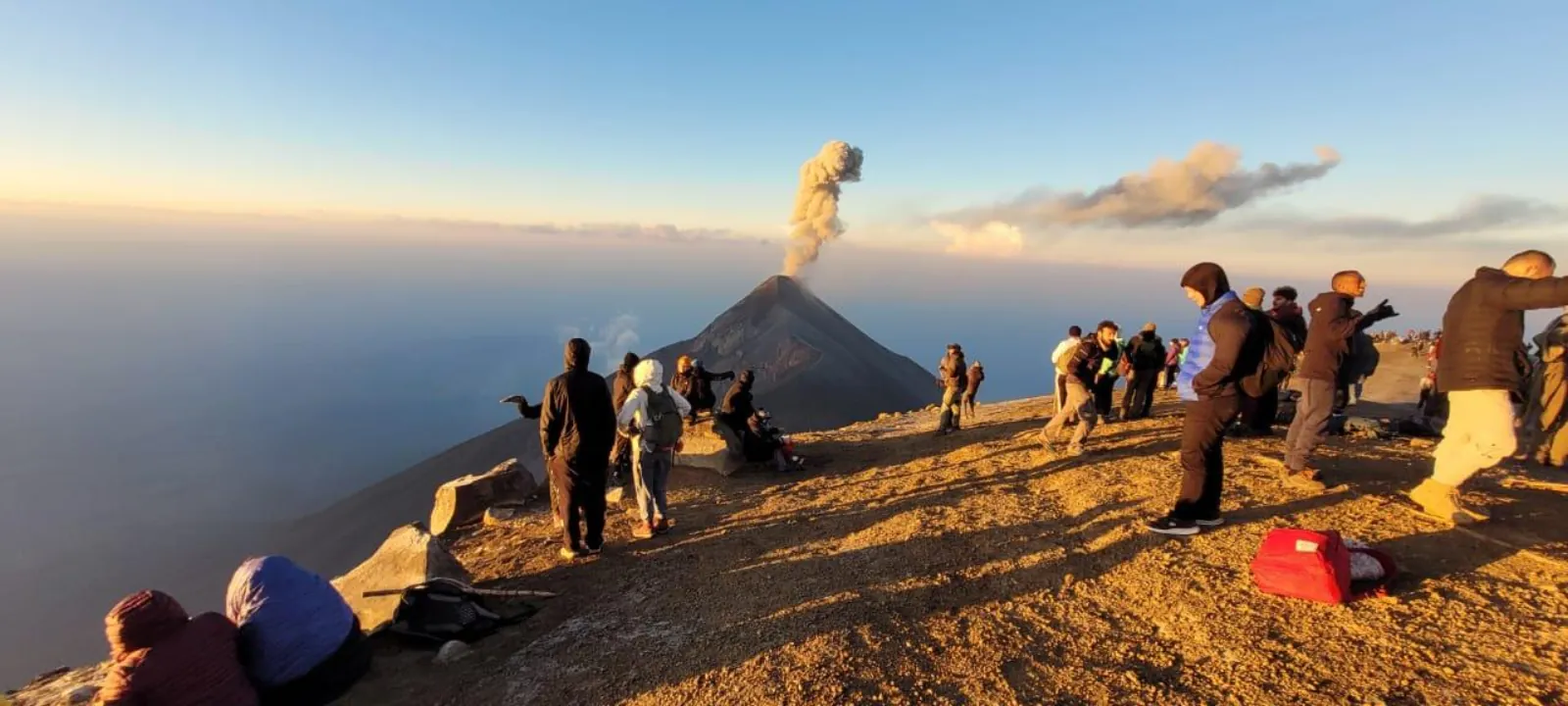
People make the hard climb despite the poor sleep for one reason. Acatenango is the platform; its neighbor, Fuego, is active, and the two summits stand about 3 km apart across a saddle. From a well-placed, authorized camp you may see a dark cone under the stars, lit clouds, ash plumes or glowing rock during some eruptions, and hear each boom a few seconds after the flash. Some nights you see only cloud.
The hour after sunset is often the most striking, when the last light leaves the ridge and points of light start to show on the slopes below. When wind and cloud allow, you watch Fuego’s outline change from camp or a set viewing area. It is memorable even without a lava fountain, but no one can sell it as a sure thing. Our guide to photographing Fuego at night covers the camera side.
You also sleep high. Acatenango’s summit stands at 3,976 m (13,045 ft), and Antigua at about 1,545 m (5,069 ft). Camp elevations differ by operator, roughly 3,400–3,750 m, so ask for your camp’s exact height rather than assuming every cabin sits in the same place. If conditions and your health allow, you can walk to the summit at dawn.
Cabin permits and access in 2026
Many comparison pages leave this out. On 31 March 2026, CONAP warned that unauthorized buildings, including cabins used by visitors and tourism companies, stood inside Acatenango’s legally protected area. In late May 2026 it again pointed to construction without the right authorization, damage to the ecosystem and possible risks to visitors, and it advised visitors not to stay in unauthorized structures.
That does not prove every shelter on every operator’s website is illegal, and a bookable tour does not prove a shelter is authorized. Ask for documents about your exact camp, and check with the authorities if the answer is unclear.
Fuego itself is a separate matter. Viewing Fuego from an approved Acatenango route is one thing; walking toward Fuego’s crater or crossing the saddle on a Fuego extra is another. The Municipality of Acatenango banned the route toward Fuego on 1 April 2026, CONAP, CONRED and INGUAT repeated on 25 June 2026 that the ascent is prohibited, and CONAP Resolution 01-15-2026 of July 2026 bans tourist visits to Fuego. Our Fuego climbing ban page explains the rules. Access to Acatenango can also change quickly: the park closed during Fuego’s eruption of 3 to 5 August 2026 and reopened on 7 August.
Before you book, ask in writing:
- Where exactly is the overnight camp (coordinates or a clearly named location), and who runs it?
- Is that camp structure authorized under the protected-area rules? Can you show current documents or name the approving authority?
- Which official trail and viewing points will we use? Does any extra on offer approach or enter Fuego’s restricted area?
- Which authority’s latest access notices have you checked, and when?
- If the route or camp closes, can I get a refund, rebook or switch to a permitted alternative?
- What emergency transport, communications and evacuation arrangements do you have?
If an operator brushes off these questions or says everyone does it, choose another company. A cancelled night is better than sleeping in an unapproved site while volcanic conditions change.
For the latest situation, check CONRED for disaster-risk alerts, INSIVUMEH for volcano bulletins and CONAP for protected-area rules, plus local park and municipal notices. A web page’s date is no substitute for a check on the day you leave; is Fuego erupting today gathers the latest bulletin.
Other Experiences
Other experiences you might enjoy
More overnights on Acatenango with cabins or domes at camps facing Fuego, plus Pacaya half-days and viewpoint tours from Antigua.
Shared cabins: what they are like
The usual shared option is a small wooden or panelled shelter at a mountain base camp. One operator gives you separate bunks, another side-by-side platforms, another a larger room for a dozen people. A photo of a cabin’s outside tells you little about how it feels with every bed taken.
Expect some mix of:
- A thin or medium mattress, a sleeping mat or a platform.
- A sleeping bag, and sometimes a pillow or blanket.
- Shared space with people from your hiking group.
- Headlamps switching on at odd hours for toilet trips and the summit start.
- Wind, guides making breakfast, excited hikers and, possibly, the volcano.
- Little heating and few ways to charge a phone.
CA Travelers’ listing on Viator describes cabins for up to four, a sleeping bag rated to −6 °C, the park fee and water included. Other operators equip their cabins differently, so check the details for your own date.
A shared cabin suits you if the hike and the view are what you came for, you can sleep through noise, and your operator can show the legal and safety status of its camp. It suits you less if you sleep very lightly, need privacy to change, or struggle with cold at altitude.
How many people share a cabin?
It can be two, four, six or more, depending on the tour. Several companies sell four- or five-person shared cabins, and the Pachamama listing on GetYourGuide describes a shared cabin of up to eight. Ask for the maximum occupancy of the sleeping area, and ask whether everyone in your booking gets their own sleeping surface and whether mixed groups share.
Private cabins: worth paying more?
A private cabin usually buys privacy and little else. You may get an enclosed space for two or for your group, with the same simple bedding as the shared cabins. The gains are real: fewer strangers moving around at night, more room to change into dry layers, and a chance to rest while the rest of the group talks.
A private cabin does not come with:
- A private bathroom, shower or heated room.
- A clear view of Fuego from your pillow.
- Soundproofing or a good night’s sleep.
- Better protection from altitude sickness or volcanic hazards.
- Proof that the cabin is legally approved.
Where an operator offers private cabins, confirm the exact bed layout, the camp, the current route and its authorization before you treat the sales category as settled, and ask whether the price is per person or per cabin.
For two people who can afford it and sleep badly in shared rooms, privacy is a fair upgrade. A solo traveler usually gets more from the same money spent on a skilled guide, proper thermal gear, a porter or a flexible cancellation policy.
Cabins vs tents vs glamping
Judge the shelter itself. Dome, VIP, glamping and even cabin can describe very different sleeping setups.
Cabins: a solid roof and walls can shelter you better from wind, give you a little more room to change, and reassure hikers who dislike tents. Quality varies a lot, though, and cold drafts, thin insulation and crowded bunks are all possible.
Tents: some camps use compact, weatherproof tents with the bedding already laid out. A well-pitched tent with the right mat and bag is perfectly adequate, especially if you are used to camping. Your comfort depends on the insulation under you, how exposed the tent is to wind, and condensation.
Larger safari or glamping tents may have a cot or a thicker mattress and more personal space. It is still mountain camping, so check that the tent’s site is permitted and that the promised extras work at altitude.
Ask for these instead of trusting the word VIP:
- A recent photo of the inside of the exact shelter.
- The sleeping bag’s temperature rating, and whether it is a comfort rating.
- Mattress thickness, and whether pillows and blankets are included.
- The maximum number of guests per sleeping area.
- Where the toilet is and how sheltered the site is from wind.
- Whether the view of Fuego is clear or blocked.
- Bed length, if you are taller than average.
What a typical overnight trip is like
Schedules vary by operator, trail, group pace and weather, so take this as a typical sequence and expect yours to differ.
Day 1: Antigua to base camp
Morning: you meet in Antigua, pick up or rent warm clothing, get a safety briefing, ride to the trailhead and start climbing. Most trips start at or near the village of La Soledad, but not every company uses the same route, so check the departure point.
Late morning to afternoon: the trail climbs through farmland and forest before the steeper, more exposed upper slopes, and most of the 1,500 m gain comes on loose ash. Expect frequent rests. Camp gear is usually set up already, so you carry a day or overnight pack rather than a tent, but water, spare clothes and personal items still add weight.
Afternoon: you reach camp, settle into your sleeping space, change into dry layers and eat. If the sky is clear, you watch Fuego from camp or a set viewpoint. Many people are surprised by how fast they cool down once they stop walking.
Evening: dinner, then a long, cold stretch of waiting and watching. Cloud, wind and Fuego’s activity decide what you see. Don’t wander off after dark to chase a better angle.
Day 2: optional sunrise climb and descent
Before dawn: many operators offer a summit climb that leaves around 4 a.m., often the coldest and windiest part of the trip. It is optional only where the operator and the authorities allow it. If you feel unwell, exhausted or underdressed, stay at camp.
Morning: breakfast, pack up, walk down and ride back to Antigua, usually around midday or later, depending on conditions and transport. Leave room in your plans after the hike, and don’t book a flight that depends on an on-time return. For the nights before and after the climb, our guide to where to stay in Antigua to see Fuego compares the town’s areas and hotels.
How cold is an Acatenango cabin at night?
Treat it as winter camping at altitude, even if Antigua felt warm. Around camp, nights hover near or below freezing, and wind makes them feel colder. Walls do not make a cabin heated or well insulated. Hiking guides often quote nights of about 0 °C to −5 °C, which is a planning figure; it says nothing about the weather on your date.
A sleeping bag rated to −6 °C is not necessarily comfortable at −6 °C. Limit and extreme ratings differ from the comfort rating, and people feel the cold differently. The insulation under you matters as much as the bag over you.
What to wear at camp
Dress in layers:
- A dry thermal base layer (top and leggings), kept apart from your sweaty hiking clothes.
- A fleece or other insulating mid-layer.
- A warm insulated jacket.
- A windproof, water-resistant outer layer.
- A warm hat, gloves and thick dry socks.
- Closed hiking shoes and a headlamp for the toilet or the early summit climb.
If the operator lends a jacket or gloves, check the size and condition in Antigua. Bring your own thermals and socks, keep sleeping clothes in a waterproof bag inside your pack, and don’t rely on a cotton hoodie as your only warm layer.
Toilets, showers, water, food and power
Toilets: usually basic shared latrines or composting toilets, sometimes a short walk from where you sleep; a few camps have more established facilities. Bring toilet paper and hand sanitizer, and ask about lighting at night and whether the path to the toilet crosses uneven ground.
Showers: there aren’t any to count on. Plan to wash in Antigua, and if you use wet wipes, pack them out as your guide asks.
Water: don’t assume there is water on the mountain. Ask how many liters of drinking water you must carry and whether hot drinks or refills are included. Many packing lists suggest 3–4 liters, depending on the itinerary, the weather and you. Drink to thirst and effort rather than forcing large amounts.
Meals: tours usually include lunch and dinner on day one and breakfast on day two, sometimes more. Expect simple, filling food. Tell the operator about dietary needs before booking, and carry snacks you will want to eat when you are tired and cold.
Electricity and signal: expect neither reliable power nor Wi-Fi. Use airplane mode when you can, carry a charged power bank and keep devices warm. Take route and emergency instructions from your guide.
Luggage: many hikers leave their big bag at their Antigua hotel or the operator’s office. Ask whether storage is secure and free, and whether you can collect it after checkout when you get back.
What Acatenango overnight cabins cost
There is no separate cabin price: you book a guided overnight tour and the shelter comes with it. The price depends on group size, guiding, bedding, meals, the park fee, transport, gear, the camp and the extras.
These are starting prices on the tours compared on this site; they are not quotes:
| Tour | Starting price | Where you sleep | What to check |
|---|---|---|---|
| Volcano Expeditions 2-day hiking adventure | US$57 on GetYourGuide | Dome or cabin with a mat | Park fee is extra; the loaned jacket is not waterproof |
| A-frame cabin overnight | US$90 on GetYourGuide | A-frame cabin with mattress, group of 12 at most | Q100 park fee in cash |
| CA Travelers overnight hike | US$129 on Viator | Cabin for up to four, per the listing | Final sale; the cabin layout for your date |
| Small-group hike with eruption-view cabins | US$170 on GetYourGuide, 4.4/5 from 20+ reviews | Cabin with mattress, groups of six | Few reviews so far; skip its Fuego trek |
Don’t compare headline prices alone. A cheap tour plus the park fee, a rented jacket, a headlamp, a porter and transport can cost more in total than a higher-priced package that includes them. Paying extra for a VIP cabin makes little sense if what you need is a warmer sleeping bag and a reliable guide.
Budget separately for the park fee (Q100, about US$13, in cash where the tour leaves it out), gear rental, a porter, tips and snacks. These charges change, so ask for an itemized total in quetzales or your payment currency before you pay, and don’t book a package that includes a route or Fuego extra the authorities currently prohibit.
Is a porter worth it?
Often, especially if you are not used to steep hiking at altitude. A porter carries some or all of your personal pack, usually for roughly Q200–300 each way, and the camp gear is already at the top. A porter does not remove the altitude, the gradient or the safety demands.
Check the weight allowance, whether the fee is one way or both, where the service starts and ends, and whether tips are separate. Keep your water, rain shell, warm layer, medicine, headlamp and valuables in your own pack.
Can beginners do an Acatenango cabin overnight?
The cabin does not make the climb easy. Standard routes mean 4–6 hours of steady uphill walking on loose, steep ground, then an equally hard descent, and the thin air makes ordinary effort harder. Fit, experienced hikers can still struggle, and fitness does not predict altitude sickness.
The trip is a poor match if you want a gentle scenic walk, have an injury that makes steep descents painful, cannot handle cold, or cannot safely go to high altitude. Some operators have sold a 4x4 option that cuts the walk to a shorter stretch from a high parking point, but the status of vehicle access is unsettled after CONAP’s July 2026 rules, so ask whether it is currently permitted and how far you still walk. Our Acatenango overnight tours page sets out the climb on each tour.
Altitude sickness and sleeping elevation
Acatenango’s base camps are high enough for acute mountain sickness (AMS), and many visitors reach Antigua straight from sea level. Headache with nausea, dizziness or unusual tiredness can be early signs. Severe breathlessness at rest, confusion, loss of coordination or worsening symptoms are emergencies.
The CDC Yellow Book advises gradual acclimatization and notes that sleeping above about 2,450 m can cause altitude illness in travelers who have not acclimatized. A two-day Acatenango tour climbs much faster than standard advice. A night or two in Antigua may help, but it does not remove the risk. If you have a relevant medical condition, have had altitude problems before or are pregnant, see a qualified clinician before you commit.
Never try to sleep through worsening symptoms. Tell the guide, stop climbing and go down when it is medically needed. Find out before you go who decides on a descent, how an unwell hiker is escorted down, and whether emergency evacuation is available. A private cabin does not make you safe at altitude. Our Fuego safety guide covers the other risks.
Best time of year for an overnight stay
November to April is the drier season in the Guatemalan highlands and usually gives better odds of clear skies. December to February can be especially cold and windy at camp, and holiday demand can make your preferred tour harder to book.
May to October is the rainy season, with more cloud, muddy trails, poor visibility and afternoon rain or storms. Not every day is a washout, but flexible dates help more. Closures can happen in any month because of weather, volcanic activity or management decisions.
For the view, pick a tour with a fair rebooking policy and a guide willing to make the safe call when the weather turns, and never book expecting Fuego to erupt for photos at a set hour. Our best time to see Fuego page goes month by month.
Which overnight setup to book
| Your priority | Where to start | What matters most |
|---|---|---|
| Lowest total cost | A shared tent or cabin tour | The all-in price, a safe route, bedding and guiding |
| Privacy for two | A private cabin or tent | Maximum occupancy and the camp’s permit status |
| Better sleep | A good mattress and a suitable sleeping bag | Insulation, wind exposure and noise, not the word VIP |
| Photography | An approved camp with a viewpoint facing Fuego | Orientation, a safe viewing area and flexible dates |
| Less to carry | A tour with gear set up at camp and an optional porter | Weight limits, extras and the guide |
| Less hiking | A currently permitted 4x4-assisted route | The remaining walk, access status and your fitness |
| Flexible plans | A rebookable tour with a clear closure policy | Refund terms and reliable contact |
A message to send before you book
Hi! I’m considering your Acatenango overnight tour for [date]. Can you confirm the exact camp location and its current authorization, whether the route is officially open, and whether any part enters restricted Fuego terrain? Also, how many people share the sleeping area, what is the sleeping bag’s comfort rating, is the park fee included, and what is the refund policy if the camp or trail closes? Thanks!
A professional operator answers in plain language rather than sending a generic gear list.
What to pack for the night at camp
The climbing basics matter, but these are the things hikers most often wish they had once they reach camp:
- Dry thermal sleepwear, sealed in a plastic or waterproof bag.
- Spare dry wool or synthetic socks; don’t sleep in the pair you hiked in.
- A warm beanie and gloves for sitting outside watching Fuego.
- A headlamp with fresh batteries or a full charge, for hands-free light on rough paths.
- Earplugs and an eye mask for shared sleeping.
- A power bank, with the phone kept warm in a pocket.
- Personal medication, basic first aid, sunscreen and lip balm.
- Toilet paper, hand sanitizer and a small trash bag.
- Enough water and high-energy snacks, as your guide requires.
- A rain and wind shell, even with a dry forecast.
- A camera and small tripod, only if you can carry them safely; stay out of restricted areas.
Leave behind a wheeled suitcase, extra changes of clothes and glass bottles. A light pack helps, but never save weight by dropping insulation, water or medication.
Mistakes to avoid on an Acatenango overnight
- Booking a cabin before checking its legal status. The protected-area issue is real, and a booking platform cannot settle it for you.
- Assuming a volcano view means visible lava. You may see cloud, ash, a distant glow, darkness or a dramatic eruption.
- Assuming a cabin is heated. Many are simple mountain shelters with thin walls.
- Confusing a shorter hike with an easy one. A 4x4 transfer and a good mattress do not remove the altitude risk.
- Paying for a Fuego extra without checking the ban. A seller’s itinerary may not match the official rules.
- Arriving exhausted or dehydrated. Avoid hiking straight after a long journey, rest first, and talk to a travel-health professional about the fast ascent.
- Booking a same-day onward flight. Weather and route changes are out of your hands.
- Forgetting the walk down. The steep descent is hard on knees and feet, so well-fitting shoes matter.
Choosing a cabin you can use responsibly
The night in a wooden hut is the price of the view: watching the volcanic landscape change with the light, and perhaps hearing Fuego rumble across the valley before dawn. Put the checks in this order: permission and safety first, the guide and gear second, sleep comfort third. Choose a camp that is authorized and open, confirm every inclusion, dress for real mountain cold, and leave a spare day in Antigua in case the weather or the authorities close the route. Then check dates for the A-frame cabin overnight in the GetYourGuide calendar, or compare all the tours on Acatenango overnight tours.
Frequently asked questions
Do you sleep on Acatenango or Fuego?
On Acatenango, on a standard overnight trip. Fuego is the active neighbor you watch from camp. Climbing toward Fuego is banned in 2026, so don’t book or follow a route that enters its restricted area.
Are Acatenango overnight cabins heated?
Don’t count on it. Many are basic shelters with no heating or electricity. Check your specific cabin and prepare for freezing or near-freezing nights either way.
Are the cabins private?
Some operators offer private cabins for couples or groups, while budget tours usually have shared sleeping areas. Confirm the maximum occupancy and whether the price is per person or per cabin.
Do you get a mattress and sleeping bag?
Usually, but not to the same standard everywhere. Ask about the mattress type, the sleeping bag’s comfort rating, blankets and pillows, and whether the gear is included or rented separately.
Can I see Fuego erupt from my cabin?
From some camps at some times, but never guaranteed. The shelter’s orientation, cloud, darkness and Fuego’s current activity all matter, and a safe viewpoint outside often gives a better view than the bed.
How many people share the cabins?
It varies a lot: two-person, four-person and larger shared setups all exist. Don’t judge occupancy from a promotional photo; ask for the maximum on your date.
Are there bathrooms or showers at Acatenango camp?
Expect basic shared toilets, sometimes composting toilets or latrines. Showers are not part of the high-camp night. Carry toilet paper and sanitizer.
Is camping on Acatenango legal in 2026?
It depends on the camp. CONAP warned on 31 March 2026 about cabins built without authorization in Acatenango’s protected area, and the rules depend on the exact route, location, land status and permissions. Get camp-specific confirmation from the operator, ask the relevant authority if needed, and check access notices close to your date.
Is the Fuego add-on hike allowed?
No. The Municipality of Acatenango banned the route toward Fuego on 1 April 2026, and national agencies have repeated the ban since. Don’t rely on an operator’s old listing or an optional extra at checkout; use only permitted routes and viewpoints.
Can you book a cabin without a guide?
Most cabins sold to international visitors come with a guided overnight tour. Climbing or sleeping on the mountain on your own means checking the rules, permissions and current access first; you cannot rent a cabin like a hotel room.
Can I leave my main luggage in Antigua?
Usually, at a hostel, hotel or operator’s office. Ask about security, opening hours and whether storage is included, and keep medicines, valuables and travel documents with you as your tour provider advises.
Do I need to book in advance?
For busy weekends, holidays and the few private sleeping spaces, book ahead, but only with a clear cancellation policy, because access, volcanic activity and weather can change. A fully refundable cabin is still a poor choice if no one can confirm it is authorized.
Is it worth upgrading from a tent to a cabin?
If the cabin has better insulation, wind protection and fewer people per room, often yes. Decide on those points and your tolerance for shared sleeping, and ignore the word cabin. If both are similar, a better guide and backup plan matter more.
Is the sunrise summit mandatory?
On many tours it is optional and depends on conditions. Ask before booking, and skip it if you have altitude symptoms or not enough warm gear, or if the guide says conditions are unsafe.
Pick Your Night Facing Fuego
The A-frame cabin overnight is rated 4.5 from 1,040+ reviews on GetYourGuide, with free cancellation up to 24 hours before. Check Fuego's latest activity and the park status the day before you go.
Check Dates & Tour Options